The book was written in 1990 and lacks any description of information design for the web save for a few descriptions of color and graphical interfaces. Instead, Tufte focuses on “flatland,” the static, flat world of paper. His exploration of how people “represent the rich visual world of experience and measurement on mere flatland” ranges across time and space to bring examples of both good and bad designs.
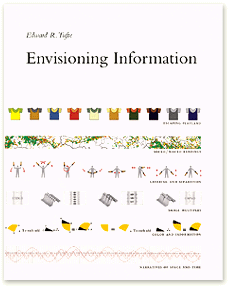 |
| Book cover image: edwardtufte.com |
The first chapter, Escaping Flatland, should be a quick introduction to the topic that invites the reader in to the work. It doesn’t quite work that way, though, due mainly to Tufte’s technical language and his quick transitions of topics and examples. In the first six pages alone he jumps from a Japanese shrine map, the shed skin of a toad, alternate designs for the periodic table, examples of three-dimensional representation, orreries, and stereoscopic images. You can tell Tufte is passionate about the topic and the first chapter is full of that excitement.
 |
| Orrery: Serendip blog, serendip.brynmawr.edu/sci_cult/evolit/s04/seti/ |
Luckily, the remaining chapters are calmer and more direct. He discusses Micro/Macro Readings next, then Layering and Separation, Small Multiples, Color and Information, and finally Narratives of Space and Time. Each chapter is an interesting examination of one aspect of information design. Examples range from Galileo’s notebooks, to train schedules, to modern art, to dance instructions. It all makes for a very stimulating read that can keep most anyone’s interest.
This is an excellent book to learn about how our design choices affect the wider world. It can be especially useful for anyone tasked with role of transforming information into visual displays like PowerPoint slides or reports.
Resources on information visualization:
Datavisualization.ch
Resources on information visualization:
Datavisualization.ch

No comments:
Post a Comment