Thursday, March 31, 2011

Envisioning Information - Edward R. Tufte (1990)

This is a classic work in the field of information design. Today, you will more often hear the phrase “information visualization” (aka, infovis) to describe the act of representing abstract data in a visual format. The goal is to make the data more accessible to a human, allowing them to gain insights from the information.

The book was written in 1990 and lacks any description of information design for the web save for a few descriptions of color and graphical interfaces. Instead, Tufte focuses on “flatland,” the static, flat world of paper. His exploration of how people “represent the rich visual world of experience and measurement on mere flatland” ranges across time and space to bring examples of both good and bad designs.
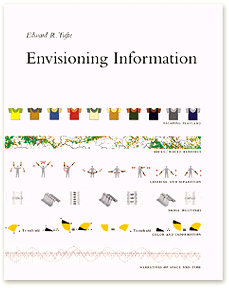
Book cover image: edwardtufte.com

The first chapter, Escaping Flatland, should be a quick introduction to the topic that invites the reader in to the work. It doesn’t quite work that way, though, due mainly to Tufte’s technical language and his quick transitions of topics and examples. In the first six pages alone he jumps from a Japanese shrine map, the shed skin of a toad, alternate designs for the periodic table, examples of three-dimensional representation, orreries, and stereoscopic images. You can tell Tufte is passionate about the topic and the first chapter is full of that excitement.


Orrery: Serendip blog, serendip.brynmawr.edu/sci_cult/evolit/s04/seti/
Luckily, the remaining chapters are calmer and more direct. He discusses Micro/Macro Readings next, then Layering and SeparationSmall MultiplesColor and Information, and finally Narratives of Space and Time. Each chapter is an interesting examination of one aspect of information design. Examples range from Galileo’s notebooks, to train schedules, to modern art, to dance instructions. It all makes for a very stimulating read that can keep most anyone’s interest.

This is an excellent book to learn about how our design choices affect the wider world. It can be especially useful for anyone tasked with role of transforming information into visual displays like PowerPoint slides or reports.


Resources on information visualization:

Datavisualization.ch


Monday, March 28, 2011

The Origins of Knowledge and Imagination - Jacob Bronowski

The best summary of The Origins of Knowledge and Imagination (1978) by Jacob Bronowski is probably from the dust jacket flap:

In this [book] Jacob Bronowski … presents a succinct introduction to the state of modern thinking about the role of science in man’s intellectual and moral life. Weaving together themes from ethnology, linguistics, philosophy, and physics, he confronts the questions of who we are, what we are, and how we relate to the universe around us.

Bronowski comes across as a talented thinker and writer in the book. He provides very clear examples of the more complex topics that allow you to follow along with his train of thought. There is a meandering to the text, though, so that some topics veer off into other areas for lengthy and often too detailed discussions (this was originally a series of lectures, though, where the sidebars may have been more effective). 

Cover Image: Yale University Press
 
Bronowski tries very hard to tie aspects of human psychology to the more rigid structure of other sciences like physics, but that is where he is least convincing in his arguments. For example, there is an analogy of compressing gas in a chamber to the psychological response of saying “Butter” to the word “Bread.” Bronowski argues that the mind is like the compressed gas because “… the nature of the connections inside must be such that when there is input, there is an enormous amount of cross-reference as the result of which there is a certain output. And it is usually the same output.” 

The general take-away from the book is: (1) man is a “special” kind of animal because of our imagination and language abilities, (2) man’s senses, developed over millennia by evolution, inform and limit our ability to interpret the world around us, (3) science is simply a structure form of language, with similar rules and requirements, but it allows us to have greater insight into the world.

Monday, March 21, 2011

Event Horizon - VHS Tape (1997)

Though it may well be the most recent floppy disk (or even hard disk), the VHS movie format is still around and some of us still own VHS players.  Our library received a large donation of VHS tapes years ago, to which we've added several cassettes from teacher reserves.  An entire aisle of one of the stacks contains just VHS tapes.  But they are rarely used, save by a few of our regulars who watch them in the library.

Event Horizon was recommended to me by a colleague as she was shelving it.  She said it was one of the scariest sci-fi movies she had seen, with images she couldn't forget.  Intrigued, I decided to take it home and dust off the VHS player.  I won't bother with a synopsis of the movie, but you can read it at IMDB.com if interested.

Box cover: Movieprop.com

The movie was interesting, but not very satisfying.  Two of us watched it and we both agreed that, though there was a lot of yelling and explosions and gore, not much really happened.  You wait for the payoff and it never really comes in the Event Horizon narrative.  Add to that a flimsily-conceived plot with the deus ex machina of sci-fi titles, an alternate dimension, and you have a movie that looks visually interesting but doesn't engage mentally.

Wednesday, March 16, 2011

The Compleat Loo: A Lavatorial Miscellany by Roger Kilroy (1996)

This book came to my attention because it was marked as a duplicate in our system and had been withdrawn. I wondered – why on Earth do we have two copies of a book about toilets? It turned out that the duplicate copy was a mistake, but now the book was on my desk. I just had to take a look at it.

Don’t we all have a sort-of fascination with other people’s bathrooms? It is such a personal, private space and offers you a small glimpse into a different life. Roger Kilroy’s book taps into that latent curiosity and provides a historical review of bathrooms throughout the ages. 

Cover image: Goodreads.com 

This book was the result of Kilroy’s other project, research on graffiti, which resulted in him spending a lot of time in public toilets. He says, “I became fascinated by the range of facilities available – from ancient channel urinals requiring delicacy of aim to massive marbled thrones which always produced a comfortable feeling of relaxation. I began to wonder what life must have been like before there were flush lavatories. What did people do?”

The Compleat Loo is more of a picture book than a scholarly attempt to detail the history and progression of toilets, but Kilroy does provide several interesting facts to consider (albeit uncited). He tells us that as far back as 2,500 BC cities in the Indus valley “had houses with bathrooms and water-flushed lavatories which were connected to a sewerage system.” An interesting turn in the history of bathrooms was the Victorian trend towards more decorative porcelain toilets – no longer merely a functional object, the toilet was also a work of art. 

Twyford’s “Unitas” image: LAL Language Centres StopPress Magazine, http://lalschools.com/

There are also beautifully done mosaics from the floors of the Orient Express bathrooms. 

Chatsworth Mosaic For The Orient Express Northern Belle image: Mosaic Mad Romans, http://www.mosaicmadromans.com

In all, this is a cute book, a nice coffee table book. It helps to satisfy some curiosity and piques other interests. 

Tuesday, March 15, 2011

Britten by David Matthews (2003)

From the cover flap:
Benjamin Britten (1913-76) was one of the outstanding British composers of the 20th century. He rose to international fame with the success of his operas, performed by his own English Opera Group, and a series of extraordinary instrumental works.
I first became of aware of Britten while working on a college paper about his opera, Peter Grimes. Up to that point, I had a casual interest in classical music and only a passing understanding of opera. But Britten’s work changed all that. His manipulation of instruments and voices to evoke human emotions was truly an eye opener. So when I saw this book for shelving, I had to pick it up.

Britten is quite a good read. Matthews chose to follow a standard biographical format – early years, adulthood, later years – so it can be hard to easily enter the story. I can imagine someone not familiar with Britten or his works being less than interested in the birth and family life of an English boy. There is also a lot of discussion of specific works, contemporaries, and technical terms, which could also be off-putting. But the author does an excellent job of cutting out the unnecessary parts of the story and focusing on those items that provide the most insight into Britten the artist.

Cover image: Brotherhood Books, http://www.brotherhoodbooks.org.au/

Matthews is not a simple biographer of Britten, however. He also provides commentary and interpretation on Britten’s day-to-day life and events and how they affect his music. In general, I think Matthews accurately helps the reader draw connections, though his approach can be a bit dramatic and psychoanalytic. For example, Matthews describes the importance of a young Britten being sung to before bed by stating:
It is almost impossible to exaggerate the importance of this archetypal maternal practice to Britten’s psyche and to his later artistic development. In adult life, Britten was never entirely able to trust the outside world. How many of us can, one might ask? Yet Britten’s uneasiness was extreme, and his music reveals it: his world is a place of danger and often terror, when innocence is readily corrupted. There can be temporary reassurance in beauty and in love, but sleep is the only sure place where security and trust may be regained. The image of sleep as a refuge is something that Britten returns to again and again in his music ….
The book itself, it should be noted, is quite handsome. An imprint from Haus Publishing of London, the cover is a black-and-white, shadowed image of Britten the conductor with only his last name printed below in blue. David Matthews’ name is noticeably absent – perhaps his nod to Britten’s talent. The book uses a different scheme for footnotes – instead of at the bottom of the page, the notes are floating captions within the text, offset by their red color. At the bottom of each page is a red heading as well, letting the other know what the general topic is on the page.  It also includes notes, a chronology, a discovered work by a young Britten, his works and recordings, an index, and sources for the pictures used.  Probably the most fully documented work I have seen.

The book is a great, quick read which hopefully will encourage others to enjoy more of Britten’s works. For more information on Britten, as well as his longtime collaborator and partner, Peter Pears, see the Britten-Pears Foundation.

Monday, March 14, 2011

The Psychology of Birds: An Interpretation of Bird Behavior by Harold E. Burtt (1967)

This book caught my interest while I was shelving. Its title is evocative – calling to mind old Sci Fi movies and odd experiments. The book itself is less of a scientific work than might be assumed by the title. It is more of a catalog of bird behavior, with assumptions for the causes of the behavior and anecdotal evidence to back-up those assumptions.

Burtt is careful to warn the reader that observed bird behaviors do not, in most cases, reflect the inner workings of a bird’s mind, nor even that the bird “thought” about its action. The tone throughout the book is of a gentle psychologist, carefully explaining complex theories in simple language to layfolk. 

Cover image: Books Illustrated by Peter Parnall, http://www.parnall.pagebooks.net/
 
Most of the book discusses a particular concept – sensations and perceptions, instincts, migrations, etc. – with a variety of particular behaviors illustrated. There is a lot of hemming, though, with Burtt stating that this “may” or “may not” be the psychology interpretation. For example, he explains why an observer needs to be critical in interpreting the bird behavior he sees:

In psychology we have a principle called the law of parsimony, which tempers such uncritical interpretation. It recommends that we should not explain the behavior by a higher-level process when we can interpret it adequately by a lower-level process. Suppose we see a house wren picking up a stick by one end and pulling it through the small entrance to his house rather than taking it by the middle and getting stuck with it across the hole. Ahah! The bird had insight into the geometry of the situation, figured that the length of the stick was greater than the diameter of the hole and acted accordingly. On the contrary, if we had been around earlier we would have seen him vainly holding sticks by the middle dozens of times and then eventually blundering into grasping one by the end and being rewarded by success; after many of these blunders and successes he finally learned how to do it. His “insight” actually was a rather low level of hit-and-miss learning (or trial-and-error, as we more frequently call it). That is the only safe explanation.

The first few chapters are an interesting read, but the formula does grow old. Some of the examples are repeated several times, so it can seem as though the material is simply being reused in later chapters. Perhaps the explosion of nature-oriented television shows also makes the text seem less special than it may have when first published.

There seems to have been a lot of interest in the book when first added to our collection. Though I’m not sure of the exact year of acquisition, the book was published in 1967 and its first checkout was in 1970. There were nine checkouts in the 70s, five in the 80s, two in the 90s, and most recently in 2008. I would imagine there would be a lot of interest from both specialists and amateur bird watchers.

Monday, March 7, 2011

The Book of Coffee & Tea - Joel, David, & Karl Schapira

This is the 1975 first edition of the book, which has subsequently been revised and reprinted.  The three authors are part of a family business in New York (Schapira's) with the motto, "It's not coffee, it's art."  The book itself is a great read, giving detailed histories of both coffee and tea, along with recipes and buying advice.  Our copy had a flurry of checkouts in the mid-90's, plus one in 2005, so the topic still seems to be of interest.

My first reaction to the book was that it was an excellent reference book, telling the background story of these two beverages in such vivid detail.  But as I read, I noticed that there are no footnotes, no citations, no references, and just a basic "Suggestions for Further Reading."  I question where the authors found the plethora of historical facts, quotes, cultural references, and ancient recipes, since there is no ability to trace the information back.  Perhaps newer editions include more detailed research material.


Cover image: Openlibrary.org

The authors go to great lengths explaining all of the political intrigue and cultural revolutions associated with both coffee and tea.  It is in those areas where I would prefer to see some sort of back-up to their claims.  For example, there is the story of how Francisco de Melo Palheta wooed the Governor of French Guinea's wife and was able to abscond with a coffee plant to Brazil, thereby starting the massive coffee plantations of that country.

Perhaps the most intriguing stories in the book have to do with the ups/downs of the coffee and tea trades, with each going through cycles of booms and busts.  It can be easy to forget how something as common as a cup of coffee or tea is really a commodity, produced in mass quantity somewhere, bought and sold in huge quantities in exchanges and markets.  There is a lot of history and international trade in each cup you drink.

The authors do a great job in telling the stories of coffee and tea.  The chapters follow the same patterns: first the background history, then how each is grown, then manufacturing, different varieties, and finally how best to enjoy these beverages and a few recipes.  There is also a short chapter on herbal teas.  An interesting part of the book is the "shopping guide" at the back - it lists different places to purchase quality coffee and tea all over the U.S., but is only 13 pages long.  There is an entry for Starbucks that makes it seem as though there was only one cafe at the time - a different world indeed!

Wednesday, March 2, 2011

Eat This, Not That! - Zinczenko and Goulding

This is one of those bulky, palm-sized, image-laden books that uses lots of flashy colors and fonts to spice-up the text.  I, for one, found all the bells and whistles distracting, which made the book difficult to read.  That seems to be the intention, though, since Eat This, Not That! is geared more to a population that wants a quick, mildly entertaining reference.  This book had the most check-outs of any I have shelved recently, so it is popular with our patrons.

Book Cover: Lakeside Musing blog, lakesidemusing.blogspot.com

I can see why it would be popular, though the value of the text is dependent on the different chain restaurants keeping specific items on their menu.  For that reason, I found most of the book useless as I don't tend to eat at fast food restaurants.  I'm also able to research nutritional information myself, so having a few select items (the "wow" items with 5,000 calories for the most part) really provided little actionable advice.

There is some worthwhile information in the book, especially when the authors focus on the nutritional value of certain foods or give a guide on how to select menu items.  For the most part, though, the book relies on the same formula as the title suggests, comparing and contrasting two menu items from a specific restaurant.  Its good for a quick peek, especially if you eat at a particular fast food restaurant frequently, but I wouldn't suggest using it as a nutritional guide.

Tuesday, March 1, 2011

Night - Elie Wiesel

This is the kind of book that knocks the wind out of you.  I saw it on the shelving cart and, knowing it is an important work, but having never read it, I started to read.  I couldn't put it down until I finished it, though, as the story swallows you whole.

Book cover from vivaciousbluesky.wordpress.com

The story leaves you feeling disoriented.  There is so much death - the physical deaths of Wiesel's family and friends, Wiesel's death of emotion, the death of humanity, God's death - that you feel like you yourself have been buried alive.  There is sadness, and shock, and dismay, and disbelief, and you feel distant from yourself and your life.  Hope is noticeably absent, even in the last sentences.  It is a supremely difficult story, amplified by the reality of it.