Wednesday, July 13, 2011

And a Bottle of Rum (2006) - Wayne Curtis

This book caught my eye while looking for something to take on a long plane ride.  As a non-fiction lover, I'm always interested in books that can tie together disparate elements for a greater understanding.  And a Bottle of Rum: A History of the New World in Ten Cocktails by Wayne Curtis is quite successful in tying together the history of rum with the development of the New World.

Cover image: rumdrinks.wordpress.com

By exploring the development, rise, fall, and steady rise again of the rum spirit, Curtis is able to deftly tell the history of the U.S. and Caribbean (though he says New World, these are really the regions he concentrates on).  The book opens your eyes to the ways in which sugar production (and hence rum production) is so entwined with the early history of the colonies - from international strife in the colonies, to slavery, to the Independence movement - and continues afterwards.  Curtis also includes several recipes at the end of the book.

Through short, at times rambling, chapters, Curtis moves through successive periods of (mostly) American history through the lens of a particular rum drink.  He touches on many different areas, like sailors in the Navy or Hemingway in Cuba, to elucidate the popularity and influence of rum.  There are times when he strains the connection and goes off on tangents (like the later chapter on tiki bars), but overall he does an excellent job in the book.

Monday, July 11, 2011

How to Be Your Dog's Best Friend (2002) - Monks of New Skete

This book is well-known in the world of dog owners, receiving both praise and scorn for its simple message of honest communication between human and canine.  It is, as a quote on the back cover notes, very "readable" and is often so much more than a dog training book.

Cover image: yimcatholic.blogspot.com

What comes across from the very start of the book is the love the Monks have for their dogs.  One of their recommendations is to integrate your dog with every possible aspect of your life, which they do in such a natural and beautiful way.  The dogs, mostly German Shepherds, are paired with a monk and spend nearly every waking moment together - from sleeping, eating, working, and playing.  To do this, the Monks require dogs that are highly trained and obedient, to ensure there is tranquility and efficiency in daily life.  Their training techniques seem to be easy to carry over into any dog owner's situation.

There are elements of the book that may be off-putting to some.  There is a high emphasis on the spiritual connection between humans and dogs, as well as the religious elements of the whole training process.  The book also discusses a telepathic connection between owner and dog, which, though earnestly described and backed by a scientific study, still struck me as a stretch to believe.

As I noted before, the book is a great read, not only for the dog training tips, but for a deeper insight into a world most of us seldom see.

Monday, June 6, 2011

Working with Aboriginal People in Remote Areas by Forrest & Sherwood (1995)

Working with Aboriginal People in Remote Areas (1995) by Simon Forrest and John Sherwood is a slim, straight-forward guide on how to interact with the Aboriginal people of Australia.  As the authors note, the book "illustrates some of the unexpected results of living with people from another culture, and reveals the ease with which we assume that our way of doing things is the normal and the best way."  The text follows that principle - that assumptions of "normal" are causes of problems in working with Aborigines - and illustrates the numerous ways that Aboriginal life diverges from our own.

Cover image: Scan of the book cover
Forrest and Sherwood discuss the many different outlooks and behaviors that are likely to cause confusion or agitation in a person unfamiliar with Aboriginal customs.  For example, they discuss the "great emphasis on sharing, which is governed by the rules of kinship" and how "sharing is a part of life and people are expected to share what they have" in Aboriginal society.  A nice feature of the book are interspersed line drawings, mostly comical, with short anecdotes.  For the "sharing" section, the line drawing is of a police officer asking an Aborigine questions about the car he is driving:

So it's not your car, but you were driving.  The bloke who owns it is your cousin, and he loaned it to your wife's brother - but he's not here, right?  No?!! Your cousin's wife borrowed it from her brother ..?
Some of the information the authors provide is more like common sense or similar principles in any tight-knit community.  There are certain areas where Aboriginal people have a very different worldview, however.  The authors relate how there is a taboo on using the first name of a person who dies, giving them instead a "replacement name."  For anyone outside of the culture, it is quite clear how a replacement name would cause confusion and trigger ill-feelings.

Though the book is intended for people working in remote Australian areas, the information would be valid for any outsider visiting a group of "foreign" people.  By not judging their ways, by not talking down to them, by respecting their traditions, you will go a long way to earning trust and respect.  This is as true in working with rural farmers in the mid-West, to inner-city dwellers of the East, to Aboriginal people in the remote parts of Australia.

Monday, May 23, 2011

Ella Minnow Pea by Mark Dunn (2001)

Ella Minnow Pea: A Novel in Letters (2001) by Mark Dunn is a quick, deceptively cute tale told in a series of letters by different characters of Nollop, a small country devoted to the sentence "A quick brown fox jumped over the lazy dog" (which includes all of the letters in the alphabet).  The sentence is immortalized in tile work, but as the letters begin falling off, the leaders of Nollop begin banning their use.  As you can imagine, the loss of letters causes many problems, clearly seen in the letters of the novel as they become more and more difficult to read.  The only solution is to come up with a new sentence containing all of the letters, but one that is shorter than the original.

Cover image: BetterWorldBooks.com

I say the book is deceptively cute, though, because the premise seems like an idea from a grade school student, but Dunn is able to weave in heavier themes.  The novel is a denunciation of governments that seek to control every aspect of their population, it is a rebuke of blind belief or faith, and it is a rumination on the way words and language and communication bind our society together.  Ella Minnow Pea remains cute, though, and very readable.

Thursday, May 19, 2011

The One-Page Project Manager by Clark A. Campbell (2006)

These types of self-help books are always difficult to evaluate.  I would bet that a seasoned project manager, one who can fully appreciate some of the stories the author relates, would find this an enjoyable read.  I, as a novice, found it mostly tedious and repetitive.  That is a shame, since much of the information is useful and relevant.

The One-Page Project Manager: Communicate and Manage Any Project with a Single Piece of Paper by Clark A. Campbell discusses the tool he and his team created for keeping track of projects.  The tool itself is very nice and quite useful - it isn't revolutionary and variations of it have been made before, but the excel sheet Campbell uses is compact and succinct.


Cover image: coverbrowser.com

Where the book gets tedious however, is Campbell's constant referencing of three different projects he worked on using the one-page excel sheet (referred in the book by the title name far too much as well).  Though I'm sure creating a warehouse is a difficult and complex task, I didn't necessarily want to know every detail while trying to understand the excel sheet.  The book also uses annoying "Key Concept" icons to point out what, to me, sounded just like common sense or rehashed tips.

I would recommend the excel spreadsheet and Campbell's useful guidance on using the tool, but skip the text on his projects.

Wednesday, May 18, 2011

Your Inner Fish by Neil Shubin (2008)

Science books for the public can often be tricky - they need to carefully balance the writing style and content to appeal to non-scientists while also conveying a complex topic.  Neil Shubin does a good job balancing these opposing needs in Your Inner Fish: A Journey Into the 3.5-Billion-Year History of the Human Body.

Your Inner Fish is all about evolution, specifically human evolution, by tracing our physical and genetic structure back in time to an ancient ancestor - an intermediary between fish and land-living animals, Tiktaalik (Inuktitut for "large freshwater fish" and it is represented on the cover).


Cover image: University of Pennsylvania

The book is well laid out and systematically goes through the various reasons why Tiktaalik is the "missing link" that fills in the evolutionary chart.  Shubin describes how the way our bones and nerves are laid out, how our body plans are designed, even how our DNA works are all linked back to these ancestors.  It is a thought-provoking work by a leading scientist in the field.

Shubin, who heads The Field Museum and lectures on anatomy at the University of Chicago, blends scientific data and explanations with personal stories and a friendly voice in his book.  The text can sound a bit condescending at times, but overall Shubin is able to simplify the topic enough for a novice to understand.  He also is able to tie together tangents to his overall theme and not allow them to steer the story off course.

Wednesday, May 4, 2011

A Natural History of the Senses by Diane Ackerman (1990)

I am normally a voracious reader of any title that begins with A Natural History of ..., but this particular volume was simply not to my liking and I found myself skipping along, leaving parts unread.  Why?  I think because Ackerman's method of narrating A Natural History of the Senses, though logical and understandable (it is broken into chapters for each sense, plus a final chapter on synesthesia), leaves you underwhelmed on the topic.  This is less a "natural history" of the senses, than a book-poem about human sensation in the many wild and colorful ways it is experienced.

Cover image: alibris.com

In the book there are many, many little anecdotes for each sense, to the point that Ackerman's larger meaning is often lost.  I often felt like I was at a party, sitting next to an overly talkative guest who insisted on sharing every bit of trivia she knew about the senses.  Ackerman also has an odd habit of throwing in irrelevant items while discussing a sense - for example, under smell she mentions that "Birds sing to announce their presence in the world, mark their territories, impress a mate, boast of their status - ultimately,  much of it has to do with sex and mating."  Fair enough, but that sentence has nothing to do with the sense of smell and could easily have been moved to the chapter on sound.  The book has many of these poetry-like inconsistencies that, for me, made this a very difficult read.

There are many moments of insight and true beauty in the book, however.  These are especially vivid when Ackerman describes one of her own experiences, like tagging Monarch butterflies and the smell of the eucalyptus forest.  I would recommend the book to a reader who enjoys a book overflowing with intricate language about human sensations, but not to someone interested in learning more about the senses.

Friday, April 29, 2011

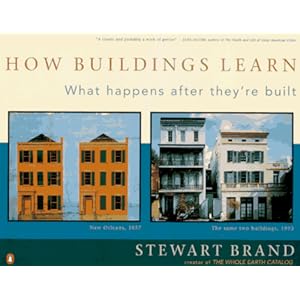
How Buildings Learn: What Happens After They're Built by Stewart Brand (1994)

Stewart Brand gives his book an intriguing and provocative title, How Buildings Learn. Perhaps a slightly better, though less flashy, title would be How Buildings Adapt, since that is truly what Brand discusses. The author is an ardent supporter of buildings, though he prefers the "low road" ones (those that are commercial, common, conservative) over the "high road" ones (those that are highly designed and unique). Why? Because Brand is much more interested in the way people interact with buildings and the synergistic relationship that results, than with the newest style or philosophy of architecture. 
Cover image: Amazon.com

Brand explores many aspects of the way buildings change and adapt over time. He lays out six S's of change in order from least to most likely to change: Site, Structure, Skin, Services, Space Plan, and Stuff.  He explores these changes through series after series of rephotographed buildings over decades, vividly showing how different S's have changed.

The author is especially harsh towards "magazine architecture" and the view that architecture is art. Brand argues that architecture should be "craft" instead, "something useful made with artfulness, with close attention to detail." He also passionately discusses the preservation movement and vernacular architecture.

The book is designed for the lay person to understand how the construct and use of buildings changed from pre-industrial times to today. Brand does an excellent job of laying out his argument and providing examples.


For more information, see:

Stewart Brand's homepage: http://web.me.com/stewartbrand/SB_homepage/Home.html

Brand at TEDTalks: http://www.ted.com/speakers/stewart_brand.html

BBC videos with Brand discussing his viewpoint available (for now) from Google Video: http://video.google.com/videoplay?docid=8639555925486210852#


Wednesday, April 27, 2011

On Modern Art by Paul Klee (1987)

This short discussion of modern art is interesting, not only because it is by a modern master, Paul Klee, but also because it explores the artistic process rather than the outcome.  Often a book on modern art will look at the products, the art pieces themselves, from the perspective of the non-artist critic who then groups works together into arbitrary categories.  Klee, however, focused on "throwing some light on those elements of the creative process which, during the growth of a work of art, take place in the subconscious."

The text was originally a lecture in Klee's native German, ably translated by Herbert Reed and laid out as an essay. Reed follows the original intent of Klee's lecture, which would have taken place in a room surrounded by his works, and supplies one of the artist's drawings on the left of every page.

Klee says the modern artist is like a tree - the artist's perception of the world around them is like the roots of the tree, supplying the sap or "passing stream of image and experience" to the trunk which is the artist himself, from which "the crown of the tree unfolds and spreads in time and space, so with his work." The simile works well since, as Klee explains, the roots and crown of the tree are not reflections of each other so it follows that modern art does not mirror the real world. Klee notes that the artist "does nothing other than gather and pass on what comes to him from the depths . . . . He is merely a channel."


Cover image: Librarything.com

Klee goes on to discuss the different dimensions present simultaneously in art, which are not easily represented with language. He talks about the "formal factors, such as line, tone value and colour," then the "dimension of figure," then "content," and finally "combination." Klee also gives a convincing argument for why modern artists' works often diverge so completely from their inspiration:

he does not attach such intense importance to natural form as do so many realist critics, because ... these final forms are not the real stuff of the process of natural creation. For he places more value on the powers which do the forming than on the final forms themselves.

Klee concludes that the artist is a type of philosopher or, more common today, a quantum physicist, who looks at the world around him and is able to say "in its present shape it is not the only possible world." That is why the artist can take inspiration from something simple, like swimming fish, and create something reminiscent but wholly different, like the Klee cover. The artist is able to look at all of the possible realms of form and represent them in his own way, free from the constraints of physicality.

Thursday, April 14, 2011

The Propensity of Things: Toward a History of Efficacy in China by Francois Jullien (1995)

Francois Jullien's The Propensity of Things: Toward a History of Efficacy in China is a very interesting, yet also very difficult, book. As Jullien notes in the introduction, he is analyzing the Chinese concept of shi, a common word for the Chinese with no fixed meaning. Shi can be translated as "'position' or 'circumstances,' and at other times as 'power' or 'potential'," but Jullien embraces the "ambivalence" of the word and gives it the far-ranging meaning of "the kind of potential that originates not in human initiative but instead results from the very disposition of things." He further explains that shi is the act of "strategically exploiting the propensity emanating from the particular configuration of reality, to the maximum effect possible. This is the notion of 'efficacy.'"


Book Cover: MIT Press


As was explored in another book I discussed, The Geography of Thought, Jullien points out that the inheritors of Greek thinking have a lot of difficulty with the lack of rigid categories and meanings in Chinese words and philosophies. He delves into the differences of the two outlooks a bit, explaining the Greek view is one of striving to be free from constraints, to be original and free, whereas the Chinese view is one of living in harmony with the world, to be in balance with the world as it is. Greek philosophy focuses on causes and effects, whereas the Chinese focus on the cyclical nature of events. Jullien's goal, though, is to ensure the reader understands that, though the concept of shi seems vague and unintuitive to us, it makes perfect sense in the Chinese worldview. By removing our "conditioning," Jullien explains, we can "deepen our own comprehension of the state of things."

Jullien writes in a way that can be difficult to understand at first. I found myself rereading paragraphs to try and grasp some of the concepts he presented. The book is also a translation from French (by Janet Lloyd) and this adds to some of the denseness of the text. A background in philosophy and Chinese culture would likely be very helpful when reading the text, though I understood most of it without these.

Jullien laid out the text in a manner that doesn't make logical sense, but does make sense for describing shi. It begins by exploring shi as "potential" in military strategy and "position" in politics, concluding that both of these fields use shi, or "manipulate" circumstances, to be effective. Next, the book explores shi in literature and art, concluding that great works have a "dynamism" at their core. This concept of shi is vividly explored in the dragon motif, where the undulating form of the dragon, half covered in clouds, embodies the concept of dynamic movement. Finally, shi is explored in history (as "situation" and "tendency") and in reality (as "propensity"). Jullien concludes by drawing several parallels between being effective in different fields by conforming in some manner.  He ends with several lines to sum up the "bipolarity" of Chinese philosophy: 

Any opening out to some Beyond, instead of leading to an endless outpouring of emotion and dizzying ecstasy, is immediately compensated with a corresponding closure. Such is the essence of the whole process and what makes it breathe. There is no need to forge a morality of sublimation. Between joy and fear, there is no need to invent salvation. It is enough to go along with change, change that is also forever regulation, change that helps to create harmony. 

Wednesday, April 13, 2011

Fences: A Play by August Wilson (1986)

Fences: A Play is part of a series of plays by August Wilson that explore the African-American experience in different decades. The setting for Fences is the 1950s, most likely in Pittsburgh, though it could be any northern, industrial town of the time. The work centers on Troy, an illiterate garbageman, his family, and his friends. Fences is ultimately about relationships, especially the choices people make when interacting with one another and how those choices affect one another.

Book cover: Webintituteforteachers.org, August Wilson Seminar

Wilson is adept at transcribing the vernacular language of the characters - each one has a unique "voice" with their own speech habits. This same aspect can make the play both difficult to understand and uncomfortable to read. Difficult, because there are certain phrasings or assumed knowledge about the African-American experience that readers may not understand. Uncomfortable, because the language is often harsh, using words that are taboo in our culture, and Wilson employs certain African-American stereotypes in the characters' traits and actions. These challenges do not hinder the play, however, but make it more tangible and real for the reader.

Monday, April 4, 2011

The Geography of Thought by Richard E. Nisbett (2003)

The Geography of Thought: How Asians and Westerners Think Differently . . . and Why by Richard E. Nisbett (2003) has an interesting thesis - that people from the West have a very different worldview than people from East Asia due to their very different cultural influences.

For the West, the main cultural influence would be Ancient Greece and "analytic" philosophers like Aristotle. This analytic view says that items are discrete and separated from the world around them (think atoms and molecules), and all of these items can be categorized into specific lists. East Asians, though, trace their culture back to Ancient China and philosophers who espoused a "holistic" outlook. This philosophy sees the relationships among items and says there is an "invisible echo" of influence radiating throughout the world. 
Cover image: Richard Nisbett U. of Mich. personal page,
www-personal.umich.edu/~nisbett

The Western worldview stems from the Greeks, specifically their notion of personal "agency." Nisbett describes this as "the sense that they were in charge of their own lives and free to act as they chose." The worldview for Asians, however, comes from Confucianism (with influences from Taoism and Buddhism) and its focus on "harmony." For East Asians, Nisbett claims, harmony means being "first and foremost a member of a collective, or rather of several collectives - the clan, the village, and especially the family." In essence, the Greeks gave their descendants a sense of individuality and the Chinese gave their descendants a sense of collective unity.

Nisbett shows how these differences of outlook affect so much of how the East and West perceive the world - from the way children are raised, to business relationships, to international relations. Some of what the author claims is well-known, whether through anecdotal stories or personal experience, but he does an excellent job of finding the roots of different traits.

Nisbett's writing gracefully skirts the line between philosophical/scientific treatise and lay person-accessible nonfiction. To support his claims, Nisbett weaves personal anecdotes and scientific findings into the narrative. Perhaps due to his academic background, there is a lot of evidence provided for different aspects of his claims, to the point you want to say "we get it, move on." The book reads quickly, though, and provides a great deal of interesting concepts.

Thursday, March 31, 2011

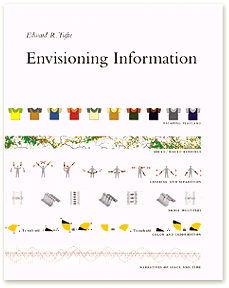
Envisioning Information - Edward R. Tufte (1990)

This is a classic work in the field of information design. Today, you will more often hear the phrase “information visualization” (aka, infovis) to describe the act of representing abstract data in a visual format. The goal is to make the data more accessible to a human, allowing them to gain insights from the information.

The book was written in 1990 and lacks any description of information design for the web save for a few descriptions of color and graphical interfaces. Instead, Tufte focuses on “flatland,” the static, flat world of paper. His exploration of how people “represent the rich visual world of experience and measurement on mere flatland” ranges across time and space to bring examples of both good and bad designs.

Book cover image: edwardtufte.com

The first chapter, Escaping Flatland, should be a quick introduction to the topic that invites the reader in to the work. It doesn’t quite work that way, though, due mainly to Tufte’s technical language and his quick transitions of topics and examples. In the first six pages alone he jumps from a Japanese shrine map, the shed skin of a toad, alternate designs for the periodic table, examples of three-dimensional representation, orreries, and stereoscopic images. You can tell Tufte is passionate about the topic and the first chapter is full of that excitement.


Orrery: Serendip blog, serendip.brynmawr.edu/sci_cult/evolit/s04/seti/
Luckily, the remaining chapters are calmer and more direct. He discusses Micro/Macro Readings next, then Layering and SeparationSmall MultiplesColor and Information, and finally Narratives of Space and Time. Each chapter is an interesting examination of one aspect of information design. Examples range from Galileo’s notebooks, to train schedules, to modern art, to dance instructions. It all makes for a very stimulating read that can keep most anyone’s interest.

This is an excellent book to learn about how our design choices affect the wider world. It can be especially useful for anyone tasked with role of transforming information into visual displays like PowerPoint slides or reports.


Resources on information visualization:

Datavisualization.ch


Monday, March 28, 2011

The Origins of Knowledge and Imagination - Jacob Bronowski

The best summary of The Origins of Knowledge and Imagination (1978) by Jacob Bronowski is probably from the dust jacket flap:

In this [book] Jacob Bronowski … presents a succinct introduction to the state of modern thinking about the role of science in man’s intellectual and moral life. Weaving together themes from ethnology, linguistics, philosophy, and physics, he confronts the questions of who we are, what we are, and how we relate to the universe around us.

Bronowski comes across as a talented thinker and writer in the book. He provides very clear examples of the more complex topics that allow you to follow along with his train of thought. There is a meandering to the text, though, so that some topics veer off into other areas for lengthy and often too detailed discussions (this was originally a series of lectures, though, where the sidebars may have been more effective). 

Cover Image: Yale University Press
 
Bronowski tries very hard to tie aspects of human psychology to the more rigid structure of other sciences like physics, but that is where he is least convincing in his arguments. For example, there is an analogy of compressing gas in a chamber to the psychological response of saying “Butter” to the word “Bread.” Bronowski argues that the mind is like the compressed gas because “… the nature of the connections inside must be such that when there is input, there is an enormous amount of cross-reference as the result of which there is a certain output. And it is usually the same output.” 

The general take-away from the book is: (1) man is a “special” kind of animal because of our imagination and language abilities, (2) man’s senses, developed over millennia by evolution, inform and limit our ability to interpret the world around us, (3) science is simply a structure form of language, with similar rules and requirements, but it allows us to have greater insight into the world.

Monday, March 21, 2011

Event Horizon - VHS Tape (1997)

Though it may well be the most recent floppy disk (or even hard disk), the VHS movie format is still around and some of us still own VHS players.  Our library received a large donation of VHS tapes years ago, to which we've added several cassettes from teacher reserves.  An entire aisle of one of the stacks contains just VHS tapes.  But they are rarely used, save by a few of our regulars who watch them in the library.

Event Horizon was recommended to me by a colleague as she was shelving it.  She said it was one of the scariest sci-fi movies she had seen, with images she couldn't forget.  Intrigued, I decided to take it home and dust off the VHS player.  I won't bother with a synopsis of the movie, but you can read it at IMDB.com if interested.

Box cover: Movieprop.com

The movie was interesting, but not very satisfying.  Two of us watched it and we both agreed that, though there was a lot of yelling and explosions and gore, not much really happened.  You wait for the payoff and it never really comes in the Event Horizon narrative.  Add to that a flimsily-conceived plot with the deus ex machina of sci-fi titles, an alternate dimension, and you have a movie that looks visually interesting but doesn't engage mentally.

Wednesday, March 16, 2011

The Compleat Loo: A Lavatorial Miscellany by Roger Kilroy (1996)

This book came to my attention because it was marked as a duplicate in our system and had been withdrawn. I wondered – why on Earth do we have two copies of a book about toilets? It turned out that the duplicate copy was a mistake, but now the book was on my desk. I just had to take a look at it.

Don’t we all have a sort-of fascination with other people’s bathrooms? It is such a personal, private space and offers you a small glimpse into a different life. Roger Kilroy’s book taps into that latent curiosity and provides a historical review of bathrooms throughout the ages. 

Cover image: Goodreads.com 

This book was the result of Kilroy’s other project, research on graffiti, which resulted in him spending a lot of time in public toilets. He says, “I became fascinated by the range of facilities available – from ancient channel urinals requiring delicacy of aim to massive marbled thrones which always produced a comfortable feeling of relaxation. I began to wonder what life must have been like before there were flush lavatories. What did people do?”

The Compleat Loo is more of a picture book than a scholarly attempt to detail the history and progression of toilets, but Kilroy does provide several interesting facts to consider (albeit uncited). He tells us that as far back as 2,500 BC cities in the Indus valley “had houses with bathrooms and water-flushed lavatories which were connected to a sewerage system.” An interesting turn in the history of bathrooms was the Victorian trend towards more decorative porcelain toilets – no longer merely a functional object, the toilet was also a work of art. 

Twyford’s “Unitas” image: LAL Language Centres StopPress Magazine, http://lalschools.com/

There are also beautifully done mosaics from the floors of the Orient Express bathrooms. 

Chatsworth Mosaic For The Orient Express Northern Belle image: Mosaic Mad Romans, http://www.mosaicmadromans.com

In all, this is a cute book, a nice coffee table book. It helps to satisfy some curiosity and piques other interests. 

Tuesday, March 15, 2011

Britten by David Matthews (2003)

From the cover flap:
Benjamin Britten (1913-76) was one of the outstanding British composers of the 20th century. He rose to international fame with the success of his operas, performed by his own English Opera Group, and a series of extraordinary instrumental works.
I first became of aware of Britten while working on a college paper about his opera, Peter Grimes. Up to that point, I had a casual interest in classical music and only a passing understanding of opera. But Britten’s work changed all that. His manipulation of instruments and voices to evoke human emotions was truly an eye opener. So when I saw this book for shelving, I had to pick it up.

Britten is quite a good read. Matthews chose to follow a standard biographical format – early years, adulthood, later years – so it can be hard to easily enter the story. I can imagine someone not familiar with Britten or his works being less than interested in the birth and family life of an English boy. There is also a lot of discussion of specific works, contemporaries, and technical terms, which could also be off-putting. But the author does an excellent job of cutting out the unnecessary parts of the story and focusing on those items that provide the most insight into Britten the artist.

Cover image: Brotherhood Books, http://www.brotherhoodbooks.org.au/

Matthews is not a simple biographer of Britten, however. He also provides commentary and interpretation on Britten’s day-to-day life and events and how they affect his music. In general, I think Matthews accurately helps the reader draw connections, though his approach can be a bit dramatic and psychoanalytic. For example, Matthews describes the importance of a young Britten being sung to before bed by stating:
It is almost impossible to exaggerate the importance of this archetypal maternal practice to Britten’s psyche and to his later artistic development. In adult life, Britten was never entirely able to trust the outside world. How many of us can, one might ask? Yet Britten’s uneasiness was extreme, and his music reveals it: his world is a place of danger and often terror, when innocence is readily corrupted. There can be temporary reassurance in beauty and in love, but sleep is the only sure place where security and trust may be regained. The image of sleep as a refuge is something that Britten returns to again and again in his music ….
The book itself, it should be noted, is quite handsome. An imprint from Haus Publishing of London, the cover is a black-and-white, shadowed image of Britten the conductor with only his last name printed below in blue. David Matthews’ name is noticeably absent – perhaps his nod to Britten’s talent. The book uses a different scheme for footnotes – instead of at the bottom of the page, the notes are floating captions within the text, offset by their red color. At the bottom of each page is a red heading as well, letting the other know what the general topic is on the page.  It also includes notes, a chronology, a discovered work by a young Britten, his works and recordings, an index, and sources for the pictures used.  Probably the most fully documented work I have seen.

The book is a great, quick read which hopefully will encourage others to enjoy more of Britten’s works. For more information on Britten, as well as his longtime collaborator and partner, Peter Pears, see the Britten-Pears Foundation.

Monday, March 14, 2011

The Psychology of Birds: An Interpretation of Bird Behavior by Harold E. Burtt (1967)

This book caught my interest while I was shelving. Its title is evocative – calling to mind old Sci Fi movies and odd experiments. The book itself is less of a scientific work than might be assumed by the title. It is more of a catalog of bird behavior, with assumptions for the causes of the behavior and anecdotal evidence to back-up those assumptions.

Burtt is careful to warn the reader that observed bird behaviors do not, in most cases, reflect the inner workings of a bird’s mind, nor even that the bird “thought” about its action. The tone throughout the book is of a gentle psychologist, carefully explaining complex theories in simple language to layfolk. 

Cover image: Books Illustrated by Peter Parnall, http://www.parnall.pagebooks.net/
 
Most of the book discusses a particular concept – sensations and perceptions, instincts, migrations, etc. – with a variety of particular behaviors illustrated. There is a lot of hemming, though, with Burtt stating that this “may” or “may not” be the psychology interpretation. For example, he explains why an observer needs to be critical in interpreting the bird behavior he sees:

In psychology we have a principle called the law of parsimony, which tempers such uncritical interpretation. It recommends that we should not explain the behavior by a higher-level process when we can interpret it adequately by a lower-level process. Suppose we see a house wren picking up a stick by one end and pulling it through the small entrance to his house rather than taking it by the middle and getting stuck with it across the hole. Ahah! The bird had insight into the geometry of the situation, figured that the length of the stick was greater than the diameter of the hole and acted accordingly. On the contrary, if we had been around earlier we would have seen him vainly holding sticks by the middle dozens of times and then eventually blundering into grasping one by the end and being rewarded by success; after many of these blunders and successes he finally learned how to do it. His “insight” actually was a rather low level of hit-and-miss learning (or trial-and-error, as we more frequently call it). That is the only safe explanation.

The first few chapters are an interesting read, but the formula does grow old. Some of the examples are repeated several times, so it can seem as though the material is simply being reused in later chapters. Perhaps the explosion of nature-oriented television shows also makes the text seem less special than it may have when first published.

There seems to have been a lot of interest in the book when first added to our collection. Though I’m not sure of the exact year of acquisition, the book was published in 1967 and its first checkout was in 1970. There were nine checkouts in the 70s, five in the 80s, two in the 90s, and most recently in 2008. I would imagine there would be a lot of interest from both specialists and amateur bird watchers.

Monday, March 7, 2011

The Book of Coffee & Tea - Joel, David, & Karl Schapira

This is the 1975 first edition of the book, which has subsequently been revised and reprinted.  The three authors are part of a family business in New York (Schapira's) with the motto, "It's not coffee, it's art."  The book itself is a great read, giving detailed histories of both coffee and tea, along with recipes and buying advice.  Our copy had a flurry of checkouts in the mid-90's, plus one in 2005, so the topic still seems to be of interest.

My first reaction to the book was that it was an excellent reference book, telling the background story of these two beverages in such vivid detail.  But as I read, I noticed that there are no footnotes, no citations, no references, and just a basic "Suggestions for Further Reading."  I question where the authors found the plethora of historical facts, quotes, cultural references, and ancient recipes, since there is no ability to trace the information back.  Perhaps newer editions include more detailed research material.


Cover image: Openlibrary.org

The authors go to great lengths explaining all of the political intrigue and cultural revolutions associated with both coffee and tea.  It is in those areas where I would prefer to see some sort of back-up to their claims.  For example, there is the story of how Francisco de Melo Palheta wooed the Governor of French Guinea's wife and was able to abscond with a coffee plant to Brazil, thereby starting the massive coffee plantations of that country.

Perhaps the most intriguing stories in the book have to do with the ups/downs of the coffee and tea trades, with each going through cycles of booms and busts.  It can be easy to forget how something as common as a cup of coffee or tea is really a commodity, produced in mass quantity somewhere, bought and sold in huge quantities in exchanges and markets.  There is a lot of history and international trade in each cup you drink.

The authors do a great job in telling the stories of coffee and tea.  The chapters follow the same patterns: first the background history, then how each is grown, then manufacturing, different varieties, and finally how best to enjoy these beverages and a few recipes.  There is also a short chapter on herbal teas.  An interesting part of the book is the "shopping guide" at the back - it lists different places to purchase quality coffee and tea all over the U.S., but is only 13 pages long.  There is an entry for Starbucks that makes it seem as though there was only one cafe at the time - a different world indeed!

Wednesday, March 2, 2011

Eat This, Not That! - Zinczenko and Goulding

This is one of those bulky, palm-sized, image-laden books that uses lots of flashy colors and fonts to spice-up the text.  I, for one, found all the bells and whistles distracting, which made the book difficult to read.  That seems to be the intention, though, since Eat This, Not That! is geared more to a population that wants a quick, mildly entertaining reference.  This book had the most check-outs of any I have shelved recently, so it is popular with our patrons.

Book Cover: Lakeside Musing blog, lakesidemusing.blogspot.com

I can see why it would be popular, though the value of the text is dependent on the different chain restaurants keeping specific items on their menu.  For that reason, I found most of the book useless as I don't tend to eat at fast food restaurants.  I'm also able to research nutritional information myself, so having a few select items (the "wow" items with 5,000 calories for the most part) really provided little actionable advice.

There is some worthwhile information in the book, especially when the authors focus on the nutritional value of certain foods or give a guide on how to select menu items.  For the most part, though, the book relies on the same formula as the title suggests, comparing and contrasting two menu items from a specific restaurant.  Its good for a quick peek, especially if you eat at a particular fast food restaurant frequently, but I wouldn't suggest using it as a nutritional guide.

Tuesday, March 1, 2011

Night - Elie Wiesel

This is the kind of book that knocks the wind out of you.  I saw it on the shelving cart and, knowing it is an important work, but having never read it, I started to read.  I couldn't put it down until I finished it, though, as the story swallows you whole.

Book cover from vivaciousbluesky.wordpress.com

The story leaves you feeling disoriented.  There is so much death - the physical deaths of Wiesel's family and friends, Wiesel's death of emotion, the death of humanity, God's death - that you feel like you yourself have been buried alive.  There is sadness, and shock, and dismay, and disbelief, and you feel distant from yourself and your life.  Hope is noticeably absent, even in the last sentences.  It is a supremely difficult story, amplified by the reality of it.

Monday, February 28, 2011

The Journey of the Mind to God - Saint Bonaventure

This is a slim, 99-page book that is so packed with dense writing that it takes three readings just to barely grasp some of the concepts.  Saint Bonaventure's (1217-1274) text only takes up a little more than a third of the book, the remainder being introductory information and footnotes.  It is those two extra elements that really make this book a worthwhile read, as they allow a modern reader to more deeply comprehend the concepts Bonaventure lays out.

Book cover: Amazon.com

This 1993 version of Bonaventure's work is a translation from Latin by Philotheus Boehner that has been edited, as well as given an introduction and explanatory notes, by Stephen F. Brown.  Mr. Brown says he chose the Boehner translation because it "stays very close to the Latin and is generally quite readable."  I would have to agree with that statement, as some of the other versions of The Journey of the Mind to God (also known as The Itinerarium) available online were not nearly as easy to comprehend.

As I mentioned earlier, it is the material Brown provides that truly helps to make Bonaventure's work accessible to a modern audience.  Brown tells us from the very beginning that this work will be very different from other texts because 1) Bonaventure uses ample symbolism to represent complex concepts and 2) this is more of a technical university sermon.  Brown's text is clear and well-written, and it often uses a simple metaphor or description to illuminate a point, such as these sentences to explain Bonaventure's worldview:
[He] never viewed the world in a hard-nosed, factual way.  A rose, for him, was always more than a rose.  Or, perhaps, we might better say that for Saint Bonaventure a rose, while remaining a rose, tells an attentive viewer a richer story of its reality.
Or these to explain the "illumination theory of knowledge" developed by Augustine and embraced by Bonaventure: 
[According to the theory], the first thing we know is God, even though we are not aware of this at first. Just as we would not see the colors and shapes of a stained-glass window unless the invisible sun was illuminating them, so we would not see visible things if the invisible God was not illuminating them from within. God, then, is present in things, and if we analyze our sense knowledge, our enjoyment of sense objects, and the judgments we make concerning them, we would come to realize God's invisible presence in them.
Bonaventure himself relies on these common images or experiences to elucidate a point as well.  The majority of his text, however, is very dense.  I mean "dense" in the sense that there is a layering effect to how he has written the work, where concepts are built up over the chapters as Bonaventure rigorously argues out his philosophy.  There is also a purposeful use of repetition and contrast, so that one concept might be described six different ways, along with six opposite descriptions, to fully flesh out the complexity of what he is describing.

Bonaventure uses a term I had never heard before, but t seems to be popular is religious and philosophical texts: synderesis. Brown's note on the concept states that Bonaventure uses synderesis ".... as the highest power of reason and describes it as the natural gravity of the soul toward the good"  Bonaventure also calls it "the unitive" or "loving power."  I wasn't too satisfied with that definition, so I took a look at how Philosophy Pages defines it:
Immediate, intuitive apprehension of the fundamental principles of morality. For such medieval ethicists as Peter Lombard and Aquinas, synderesis, unlike mere conscience, is both infallible and general.
Perhaps not much clearer, but a bit helpful.

Overall, it is an excellent book to learn more about Saint Bonaventure and Franciscan religious philosophy.  It is also an interesting insight into a deeply religious mind, that allows you to experience some of what made Bonaventure such an ardent believer in God. 


Other Resources:

http://www.crossroadsinitiative.com/library_article/666/Journey_of_the_Mind_into_God_St_Bonaventure.html

http://www.catholic-forum.com/saints/stb16012.htm

http://books.google.com/books?id=J2zyOEvN_74C&dq=the+journey+of+the+mind+to+god&source=gbs_navlinks_s

http://www.ntslibrary.com/PDF%20Books/Bonaventure%20Journey%20of%20the%20Mind%20Into%20God.pdf

Tuesday, February 22, 2011

Repetitive Strain Injury: A Computer User's Guide - Pascarelli & Quilter

This was a quirk of coincidence, as I have recently been thinking about typing and carpal tunnel syndrome.  It looks like the last time the book was checked out was in 1995 (a year after the publication date), so it has been on the shelves for a while.  I am glad someone decided to give it a look, though, as the book does have some great information.

Book cover: Amazon.com
Pascarelli, Emil and Deborah Quilter.  1994.  Repetitive Strain Injury: A Computer User's Guide.  NY: John Wiley & Sons.


Though the book spends what, to me, seemed like an inordinate amount of time describing computer work, detailing modern jobs, and discussing the ignorance of today's (or 1990's) corporations, the authors also do provide helpful hints on preventing and dealing with repetitive strain injury (RSI).  As the authors note, RSI is much more than just carpal tunnel syndrome and includes a wide range of injuries in relation to using computers.  The information on stretching is especially useful for anyone who uses a keyboard for the majority of the day.

Deborah Quilter also has a site on RSI - RSIHelp.com - though the last update seems to have been in 2009.

Emil Pascarelli also wrote a book in 2004 on RSI - Dr. Pascarelli's Complete Guide to Repetitive Strain Injury: What You Need to Know About RSI and Carpal Tunnel Syndrome.