Friday, April 29, 2011

How Buildings Learn: What Happens After They're Built by Stewart Brand (1994)

Stewart Brand gives his book an intriguing and provocative title, How Buildings Learn. Perhaps a slightly better, though less flashy, title would be How Buildings Adapt, since that is truly what Brand discusses. The author is an ardent supporter of buildings, though he prefers the "low road" ones (those that are commercial, common, conservative) over the "high road" ones (those that are highly designed and unique). Why? Because Brand is much more interested in the way people interact with buildings and the synergistic relationship that results, than with the newest style or philosophy of architecture. 
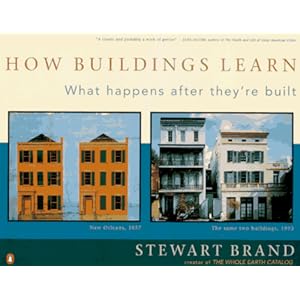
Cover image: Amazon.com

Brand explores many aspects of the way buildings change and adapt over time. He lays out six S's of change in order from least to most likely to change: Site, Structure, Skin, Services, Space Plan, and Stuff.  He explores these changes through series after series of rephotographed buildings over decades, vividly showing how different S's have changed.

The author is especially harsh towards "magazine architecture" and the view that architecture is art. Brand argues that architecture should be "craft" instead, "something useful made with artfulness, with close attention to detail." He also passionately discusses the preservation movement and vernacular architecture.

The book is designed for the lay person to understand how the construct and use of buildings changed from pre-industrial times to today. Brand does an excellent job of laying out his argument and providing examples.


For more information, see:

Stewart Brand's homepage: http://web.me.com/stewartbrand/SB_homepage/Home.html

Brand at TEDTalks: http://www.ted.com/speakers/stewart_brand.html

BBC videos with Brand discussing his viewpoint available (for now) from Google Video: http://video.google.com/videoplay?docid=8639555925486210852#


Wednesday, April 27, 2011

On Modern Art by Paul Klee (1987)

This short discussion of modern art is interesting, not only because it is by a modern master, Paul Klee, but also because it explores the artistic process rather than the outcome.  Often a book on modern art will look at the products, the art pieces themselves, from the perspective of the non-artist critic who then groups works together into arbitrary categories.  Klee, however, focused on "throwing some light on those elements of the creative process which, during the growth of a work of art, take place in the subconscious."

The text was originally a lecture in Klee's native German, ably translated by Herbert Reed and laid out as an essay. Reed follows the original intent of Klee's lecture, which would have taken place in a room surrounded by his works, and supplies one of the artist's drawings on the left of every page.

Klee says the modern artist is like a tree - the artist's perception of the world around them is like the roots of the tree, supplying the sap or "passing stream of image and experience" to the trunk which is the artist himself, from which "the crown of the tree unfolds and spreads in time and space, so with his work." The simile works well since, as Klee explains, the roots and crown of the tree are not reflections of each other so it follows that modern art does not mirror the real world. Klee notes that the artist "does nothing other than gather and pass on what comes to him from the depths . . . . He is merely a channel."


Cover image: Librarything.com

Klee goes on to discuss the different dimensions present simultaneously in art, which are not easily represented with language. He talks about the "formal factors, such as line, tone value and colour," then the "dimension of figure," then "content," and finally "combination." Klee also gives a convincing argument for why modern artists' works often diverge so completely from their inspiration:

he does not attach such intense importance to natural form as do so many realist critics, because ... these final forms are not the real stuff of the process of natural creation. For he places more value on the powers which do the forming than on the final forms themselves.

Klee concludes that the artist is a type of philosopher or, more common today, a quantum physicist, who looks at the world around him and is able to say "in its present shape it is not the only possible world." That is why the artist can take inspiration from something simple, like swimming fish, and create something reminiscent but wholly different, like the Klee cover. The artist is able to look at all of the possible realms of form and represent them in his own way, free from the constraints of physicality.

Thursday, April 14, 2011

The Propensity of Things: Toward a History of Efficacy in China by Francois Jullien (1995)

Francois Jullien's The Propensity of Things: Toward a History of Efficacy in China is a very interesting, yet also very difficult, book. As Jullien notes in the introduction, he is analyzing the Chinese concept of shi, a common word for the Chinese with no fixed meaning. Shi can be translated as "'position' or 'circumstances,' and at other times as 'power' or 'potential'," but Jullien embraces the "ambivalence" of the word and gives it the far-ranging meaning of "the kind of potential that originates not in human initiative but instead results from the very disposition of things." He further explains that shi is the act of "strategically exploiting the propensity emanating from the particular configuration of reality, to the maximum effect possible. This is the notion of 'efficacy.'"


Book Cover: MIT Press


As was explored in another book I discussed, The Geography of Thought, Jullien points out that the inheritors of Greek thinking have a lot of difficulty with the lack of rigid categories and meanings in Chinese words and philosophies. He delves into the differences of the two outlooks a bit, explaining the Greek view is one of striving to be free from constraints, to be original and free, whereas the Chinese view is one of living in harmony with the world, to be in balance with the world as it is. Greek philosophy focuses on causes and effects, whereas the Chinese focus on the cyclical nature of events. Jullien's goal, though, is to ensure the reader understands that, though the concept of shi seems vague and unintuitive to us, it makes perfect sense in the Chinese worldview. By removing our "conditioning," Jullien explains, we can "deepen our own comprehension of the state of things."

Jullien writes in a way that can be difficult to understand at first. I found myself rereading paragraphs to try and grasp some of the concepts he presented. The book is also a translation from French (by Janet Lloyd) and this adds to some of the denseness of the text. A background in philosophy and Chinese culture would likely be very helpful when reading the text, though I understood most of it without these.

Jullien laid out the text in a manner that doesn't make logical sense, but does make sense for describing shi. It begins by exploring shi as "potential" in military strategy and "position" in politics, concluding that both of these fields use shi, or "manipulate" circumstances, to be effective. Next, the book explores shi in literature and art, concluding that great works have a "dynamism" at their core. This concept of shi is vividly explored in the dragon motif, where the undulating form of the dragon, half covered in clouds, embodies the concept of dynamic movement. Finally, shi is explored in history (as "situation" and "tendency") and in reality (as "propensity"). Jullien concludes by drawing several parallels between being effective in different fields by conforming in some manner.  He ends with several lines to sum up the "bipolarity" of Chinese philosophy: 

Any opening out to some Beyond, instead of leading to an endless outpouring of emotion and dizzying ecstasy, is immediately compensated with a corresponding closure. Such is the essence of the whole process and what makes it breathe. There is no need to forge a morality of sublimation. Between joy and fear, there is no need to invent salvation. It is enough to go along with change, change that is also forever regulation, change that helps to create harmony. 

Wednesday, April 13, 2011

Fences: A Play by August Wilson (1986)

Fences: A Play is part of a series of plays by August Wilson that explore the African-American experience in different decades. The setting for Fences is the 1950s, most likely in Pittsburgh, though it could be any northern, industrial town of the time. The work centers on Troy, an illiterate garbageman, his family, and his friends. Fences is ultimately about relationships, especially the choices people make when interacting with one another and how those choices affect one another.

Book cover: Webintituteforteachers.org, August Wilson Seminar

Wilson is adept at transcribing the vernacular language of the characters - each one has a unique "voice" with their own speech habits. This same aspect can make the play both difficult to understand and uncomfortable to read. Difficult, because there are certain phrasings or assumed knowledge about the African-American experience that readers may not understand. Uncomfortable, because the language is often harsh, using words that are taboo in our culture, and Wilson employs certain African-American stereotypes in the characters' traits and actions. These challenges do not hinder the play, however, but make it more tangible and real for the reader.

Monday, April 4, 2011

The Geography of Thought by Richard E. Nisbett (2003)

The Geography of Thought: How Asians and Westerners Think Differently . . . and Why by Richard E. Nisbett (2003) has an interesting thesis - that people from the West have a very different worldview than people from East Asia due to their very different cultural influences.

For the West, the main cultural influence would be Ancient Greece and "analytic" philosophers like Aristotle. This analytic view says that items are discrete and separated from the world around them (think atoms and molecules), and all of these items can be categorized into specific lists. East Asians, though, trace their culture back to Ancient China and philosophers who espoused a "holistic" outlook. This philosophy sees the relationships among items and says there is an "invisible echo" of influence radiating throughout the world. 
Cover image: Richard Nisbett U. of Mich. personal page,
www-personal.umich.edu/~nisbett

The Western worldview stems from the Greeks, specifically their notion of personal "agency." Nisbett describes this as "the sense that they were in charge of their own lives and free to act as they chose." The worldview for Asians, however, comes from Confucianism (with influences from Taoism and Buddhism) and its focus on "harmony." For East Asians, Nisbett claims, harmony means being "first and foremost a member of a collective, or rather of several collectives - the clan, the village, and especially the family." In essence, the Greeks gave their descendants a sense of individuality and the Chinese gave their descendants a sense of collective unity.

Nisbett shows how these differences of outlook affect so much of how the East and West perceive the world - from the way children are raised, to business relationships, to international relations. Some of what the author claims is well-known, whether through anecdotal stories or personal experience, but he does an excellent job of finding the roots of different traits.

Nisbett's writing gracefully skirts the line between philosophical/scientific treatise and lay person-accessible nonfiction. To support his claims, Nisbett weaves personal anecdotes and scientific findings into the narrative. Perhaps due to his academic background, there is a lot of evidence provided for different aspects of his claims, to the point you want to say "we get it, move on." The book reads quickly, though, and provides a great deal of interesting concepts.